

og:description Repeats og:title: How to Fix It
When og:description repeats og:title, the card says one line twice. Add a fact the title leaves out, then check the live URL before sharing.
By Abid Ali, maintainer of OG Scope
Published
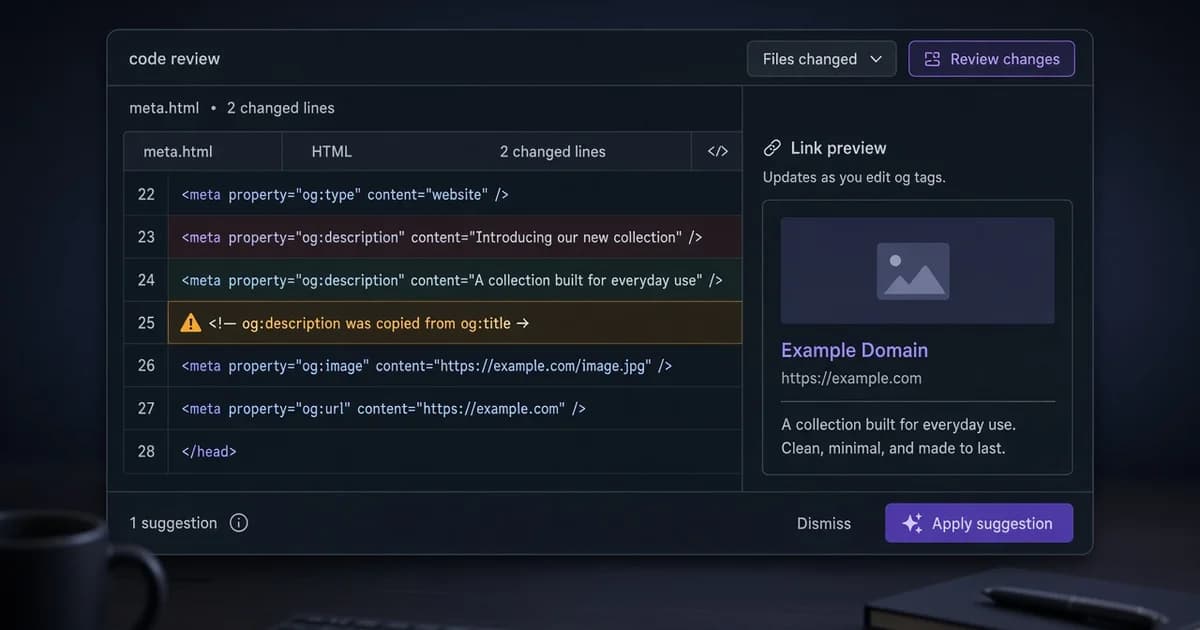
An og description same as title means og:description and og:title carry the same words. The card still appears. The line under the headline repeats the headline, so a reader learns nothing new before they open the page.
The two tags have different jobs. The title names the page. The description adds one fact the title left out. The og:title guide covers length and the HTML title. The og:description guide covers the tag itself. This page is the case where the two strings match.
og:description vs og:title
A duplicate og description is easy to ship. A template fills both tags from one CMS field. A plugin copies the title when the excerpt is empty. A social field is left blank and the theme falls back to the headline. The HTML looks complete because both tags are present.
<meta property="og:title" content="Spring planting workshop, March 14" />
<meta property="og:description" content="Spring planting workshop, March 14" />
Replace the description with a sentence that can stand under the title. Keep the title as the name. Put the time, the format, or the outcome in the second tag.
<meta property="og:title" content="Spring planting workshop, March 14" />
<meta property="og:description" content="A two-hour session on seed starting and bed preparation." />
Compare the strings after you trim spaces and ignore letter case. "Spring Planting Workshop" and "spring planting workshop" are the same line. A description that is only the title plus a period is still a repeat.
What to write instead
One sentence is enough. The practical og description length is one or two sentences, with the point in the first sentence, because cards trim the rest. Do not start with the site name. The domain and og:site_name already say where the link goes.
- A post: the title is the headline. The description is the result or the person it is for.
- A product: the title is the name. The description is the size, the material, or the price, if that fact is allowed on the card.
- A docs page: the title is the feature. The description is the task the page helps someone finish.
- An event: the title is the name and date. The description is the length and the place, or the length and who it is for.
If the only available text is the title, write a new sentence. Do not paste the first paragraph of the article when that paragraph opens with the same headline. Do not paste a keyword list.
Templates that copy the title
Check the head in the page source, not the field in the CMS alone. Some themes print og:description from the SEO title when the meta description is empty. Filling the meta description with a real summary fixes both the search snippet and the share card, as long as the theme uses that field for og:description.
A React or Vue page that sets both tags from one variable will repeat on every route. Pass a second string. If a route has no summary yet, omit og:description rather than copying og:title. A missing description can fall back to the meta description. A copied title cannot.
twitter:description has the same trap. Leave it unset when it would only repeat og:title or og:description. Set it when the X card needs a shorter line than the Open Graph description.
Close matches that still repeat
A description that adds only the brand, a colon, or the word "official" is still the title for a reader. "Field notes: Field notes from a wet week" spends the second line on the site name. Move the brand to og:site_name and use the description for what changed in the wet week.
Quoting the title inside a longer sentence can be useful when the sentence adds a fact: "Notes from a wet week, including which beds flooded." Quoting it and stopping is a duplicate og description with extra punctuation. Read the two tags aloud, one after the other. If the second reading adds no noun the first did not have, rewrite it.
The same test applies when the HTML title, the meta description, and both Open Graph tags are one string. Fix og:title and og:description first, because those are what the share card reads. Then give the meta description its own sentence if the search snippet should differ from the card.
A product feed that sets every description to the product name will repeat on every URL. Map the description from a short field, such as a one-line summary, and leave it empty when that field is blank. An empty tag is easier to spot in the checker than a tag that copies the name on hundreds of pages. Fix the template once, then spot-check a homepage, a post, and a product rather than editing each URL by hand. One corrected template fixes every URL that uses it.
Check the live HTML
Paste the URL into the Open Graph checker. When the two Open Graph strings match, ignoring case and surrounding spaces, the description row notes the repeat. The estimated cards show the title and the description together, which makes the duplicate obvious. The SERP preview is a separate check for the HTML title and the meta description. Those can match each other even when the Open Graph tags do not, and the other way around.
Chat apps trim harder than a feed. The WhatsApp link preview guide is one place a repeated line is especially wasteful, because the bubble may keep only a few words under the title. Fix the HTML, then share the URL again. A message already sent keeps the text it was composed with.